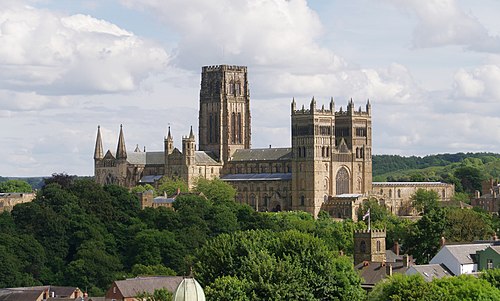
Durham Cathedral is a masterpiece of Norman architecture, built between 1093 and 1133 to house the relics of St Cuthbert and the Venerable Bede. It remains one of England’s most revered religious and architectural landmarks.
Durham Cathedral, officially known as the Cathedral Church of Christ, Blessed Mary the Virgin, and St Cuthbert of Durham, stands majestically on a rocky promontory above the River Wear in northeastern England. It was constructed in the late 11th and early 12th centuries by the Normans, primarily to enshrine the relics of St Cuthbert, a revered Anglo-Saxon saint, and later those of Bede the Venerable, a renowned scholar and monk.
The cathedral is celebrated as the finest example of Norman Romanesque architecture in Britain. Its innovative use of rib vaulting and pointed arches foreshadowed the Gothic style that would dominate later medieval architecture. The building’s massive stone structure, soaring nave, and intricately carved details reflect both the spiritual devotion and engineering prowess of its creators. One of its most remarkable features is the stone vaulted ceiling of the nave, which was unprecedented in scale at the time and remains a marvel of medieval construction.
Durham Cathedral was originally a monastic cathedral, home to a Benedictine community that played a vital role in the religious and cultural life of medieval England. The monks not only maintained the shrine of St Cuthbert but also contributed to learning and manuscript production. The cathedral’s close association with the Prince-Bishops of Durham, who wielded both spiritual and temporal power, made it a center of regional authority. The adjacent Durham Castle, also part of the UNESCO World Heritage Site, served as the bishop’s residence and fortified stronghold.
Over the centuries, Durham Cathedral has undergone various modifications, including the addition of chapels and a central tower, yet it has retained much of its original Norman character. Its survival through the Reformation and Civil War, when many religious buildings were damaged or destroyed, is a testament to its enduring significance. Today, it remains an active place of worship within the Church of England and a symbol of continuity and heritage.
The cathedral’s designation as a UNESCO World Heritage Site in 1986 underscores its global cultural importance. Visitors from around the world come to admire its architecture, explore its history, and experience its serene spiritual atmosphere. The building also serves as a venue for concerts, exhibitions, and community events, bridging its sacred past with a vibrant present.
In sum, Durham Cathedral is not merely a religious monument but a living testament to England’s medieval legacy. Its architectural brilliance, historical depth, and spiritual resonance make it a cornerstone of British heritage and a beacon of cultural identity.
Would you like a timeline of key events in the cathedral’s history or a breakdown of its architectural features? I can create either one for you.
Here’s a 500-word synopsis tracing the key events in the history of Durham Cathedral:
🏰 Durham Cathedral: A Timeline of Sacred Legacy
Durham Cathedral, one of England’s most iconic religious structures, has stood for over nine centuries as a beacon of faith, architectural innovation, and historical continuity. Its timeline is rich with spiritual, political, and cultural milestones that shaped both the cathedral and the region.
– 995 AD – Arrival of St Cuthbert’s Relics
Monks fleeing Viking raids transported the relics of St Cuthbert from Lindisfarne, eventually settling in Durham. This sacred act laid the foundation for the cathedral’s spiritual significance.
– 1093 – Construction Begins
Under Bishop William of St-Calais, the Normans began building the present cathedral to house St Cuthbert’s remains. The design showcased pioneering Romanesque architecture, including rib vaulting and massive columns.
– 1133 – Completion of the Nave and Choir
The main body of the cathedral was completed, marking a major milestone in medieval ecclesiastical architecture. It became a center of pilgrimage and monastic life.
– 1170 – Shrine of St Cuthbert Enhanced
The shrine was richly adorned, attracting pilgrims from across Europe. It became one of the most revered religious sites in England.
– 1250s – Galilee Chapel Added
This western chapel was built to house the tomb of the Venerable Bede, the great Anglo-Saxon scholar and theologian, further elevating the cathedral’s scholarly prestige.
– 1538 – Dissolution of the Monasteries
Henry VIII’s Reformation led to the suppression of the Benedictine monastery. St Cuthbert’s shrine was dismantled, and the cathedral transitioned to a Church of England institution.
– 1650s – Civil War and Puritan Iconoclasm
During Oliver Cromwell’s rule, the cathedral was used as a prison for Scottish soldiers. Many medieval furnishings and decorations were destroyed.
– 1820s – Restoration Efforts Begin
Victorian architects and clergy initiated major restoration projects, reviving the cathedral’s grandeur and preserving its medieval character.
– 1986 – UNESCO World Heritage Site Designation
Durham Cathedral, along with Durham Castle, was recognized for its outstanding universal value, securing its place among the world’s most important cultural landmarks.
– 21st Century – Modernization and Conservation
The cathedral continues to evolve, with conservation efforts, digital archives, and community engagement programs ensuring its relevance in contemporary society.
From its origins as a sanctuary for sacred relics to its role as a symbol of English heritage, Durham Cathedral’s timeline reflects resilience, reverence, and architectural brilliance. It remains a living monument—welcoming worshippers, scholars, and visitors alike into its storied halls.